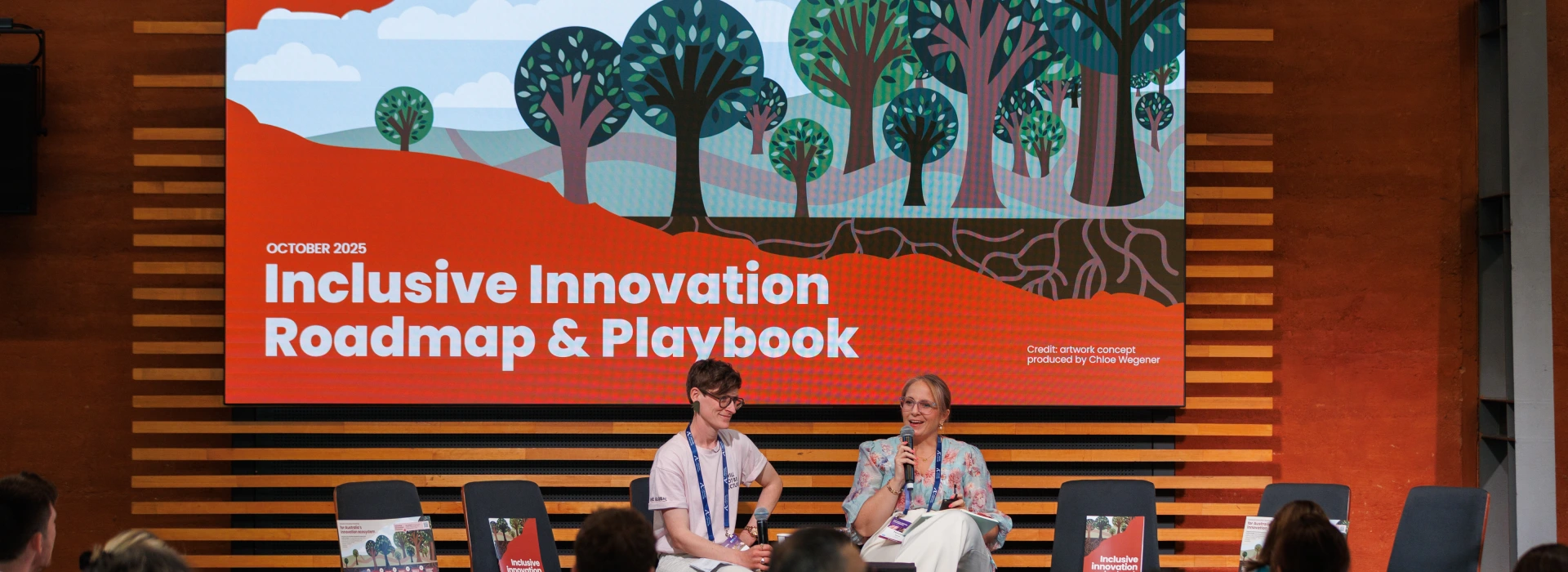
Diversity, equity, and inclusion aren't just ideals—they're key drivers of innovation and meaningful research.
Innovation thrives when diverse voices are heard, supported, and empowered. In partnership with CSIRO's ON Innovation Program (ON) and the Wiyi Yani U Thangani Institute for First Nations Gender Justice (WYUT), we set out to explore how inclusive practices can drive better outcomes for researchers, innovators, and the communities they serve. Building on the findings from this project, we've also created practical tools and recommendations to help partners across the system embed inclusive practices and sustain progress.
About the project
This project investigated how diversity, equity and inclusion (DEI) can be embedded into innovation ecosystems to ensure that all participants - regardless of background - can contribute meaningfully and benefit equitably from research translation and commercialisation efforts.
Co-led by GIWL and WYUT in collaboration with ON, the initiative aimed to:
- Identify leverage points and best practices for embedding diversity, equity and inclusion (DEI) across innovation systems.
- Develop a strategic framework to guide inclusive design, delivery, and evaluation of innovation programs.
- Analyse existing program materials and participant experiences to surface systemic barriers and opportunities for change.
Using an evidence-based, mixed-methods approach – including surveys, interviews, and policy analysis – the teams examined how inclusive practices can be scaled and sustained.
The work was grounded in principles of systems thinking, shared leadership, and continuous learning, recognising that meaningful change requires more than isolated interventions.

Why inclusive innovation matters
Research shows that inclusive innovation leads to:
- Stronger problem-solving through diverse perspectives
- Greater relevance of solutions to real-world challenges
- Improved collaboration across sectors and communities
- Enhanced commercial outcomes through broader market reach
Yet, barriers remain. From accessibility and representation to timing and communication, many innovators face systemic challenges that limit their participation and impact.

Key focus areas
The team examined:
- Accessibility: are spaces, materials, and schedules inclusive?
- Communication: are messages reaching diverse audiences effectively?
- Cohort diversity: who is participating - and who is missing?
- Policy and leadership: are DEI values reflected in practice? Responsiveness: how well do programs adapt to participant needs?


Our project partners
CSIRO ON Innovation Program
As Australia's national science agency, CSIRO works with industry, government and the research community to turn science into solutions to address Australia's greatest challenges, including food security and quality; sustainable energy and resources; health and wellbeing; resilient and valuable environments; future industries; and a secure Australia and region.
Since its development in 2015, the CSIRO ON program has delivered training and support to thousands of people. ON exists to help researchers translate their research to impact, providing the skills and confidence needed to understand and achieve the full potential of their research. Through a series of events and experiences, the program provides researchers with the skills and knowledge to realise the pathways to growth, beyond academia and commercialisation.

The Wiyi Yani U Thangani Institute
Based at the Australian National University, WYUT is Australia’s first institute dedicated to advancing the rights, knowledges, and leadership of First Nations women, girls, and gender-diverse peoples as catalysts for systemic change. The Institute is founded by June Oscar AO, who led the landmark Wiyi Yani U Thangani (Women’s Voices) Project as the former Aboriginal and Torres Strait Islander Social Justice Commissioner at the Australian Human Rights Commission.
The Institute’s purpose is to elevate First Nations women, girls and gender-diverse peoples' knowledges, lived experience and solutions as crucial to reconstructing more just, sustainable and enabling societies. As our research partners and organisational affiliates, we are proud to work alongside the WYUT at the ANU to pursue meaningful change for all women, girls and gender-diverse people.